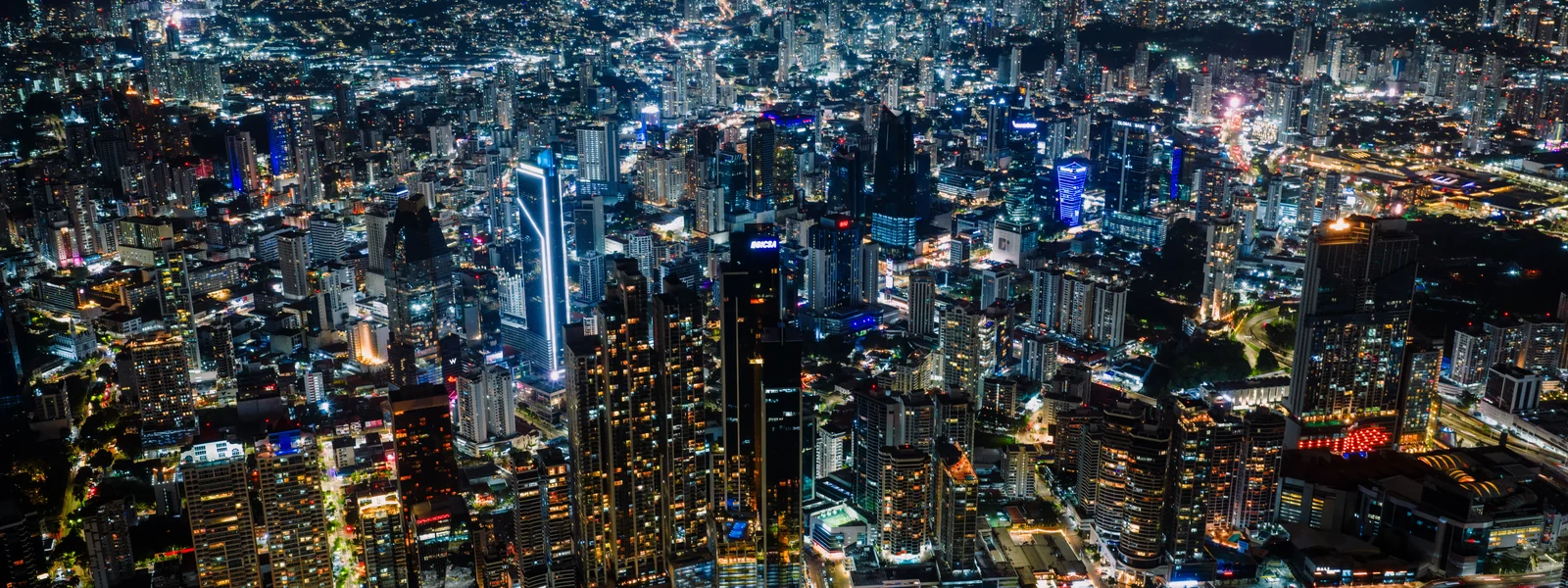
Panama 5G & 4G Coverage Map 2026
Panama has some of the best urban coverage in Central America and some of the most genuinely off-grid corners in the region, often a short boat ride apart. In Panama City you are on fast 4G with 5G arriving; on a San Blas island you have nothing at all. This guide maps what to actually expect across the three networks and the regions where signal genuinely disappears, so you plan your offline stretches rather than discovering them.
Panama City would not feel out of place among the best-connected cities anywhere. Then you take a boat to Guna Yala and the bars vanish entirely. Both are Panama.
The national picture in 2026
Panama runs on three mobile networks: +Móvil, the former Cable & Wireless operation and the heritage operator, plus Tigo and Digicel. All deliver strong service in Panama City, the Canal corridor and the populated areas. Panama City in particular is one of the best-connected cities in Central America, befitting its role as a regional banking and business hub. A travel eSIM rides on one of these networks or switches between them, and the choice matters most the further you get from the capital and the main corridor.
4G is the practical standard across covered Panama and handles everything a traveler does, including video calls and streaming. 5G is expanding in the capital but is not the factor that decides a good trip. The meaningful question here is coverage versus no coverage, because the country's geography, with remote islands and dense jungle, creates clear, predictable dead zones.
Coverage by region
This is the detailed version of the quick-reference table in the main guide. Read it as a planning tool: the strong rows you can ignore, the weak rows you plan around.
| Region | Typical service | What to expect |
|---|---|---|
| Panama City | 4G / growing 5G | Excellent across the city, the banking district, the Casco Viejo and the Canal area. |
| Canal corridor & Colon | 4G | Well covered along the Canal and the transisthmian route to the Caribbean side. |
| Boquete & David | 4G | Good in the western highland towns; thins on the mountain trails and back roads. |
| Bocas del Toro | 4G in Bocas Town, variable | Signal in the main town; patchy on the outer islands and remote beaches. |
| San Blas (Guna Yala) | Minimal to none | Remote indigenous-governed archipelago. Largely off-grid; plan to be disconnected. |
| Darien | None to weak | Remote, largely roadless jungle. Treat as fully offline. |
| Pacific beaches & interior | 4G near towns, gaps around | Good near the developed coast and towns; thins in the rural interior. |
The San Blas islands, or Guna Yala, are an autonomous indigenous comarca governed by the Guna people, made up of hundreds of small islands. The combination of remoteness, the islands' small size, and limited infrastructure means mobile coverage is minimal to nonexistent across most of the archipelago. This is not a network failure to solve with a different eSIM; it is simply a remote, self-governed region without towers. Visitors treat San Blas as off-grid, which is a large part of its appeal.
5G in Panama: real, but not the deciding factor
5G is arriving in Panama City and where present it is fast. But for a traveler it is rarely what decides a trip, because 4G across covered Panama already delivers more than enough speed for maps, calls, streaming and tethering. Paying a premium specifically for 5G makes little sense when most of your data outside the capital passes through 4G anyway, and that 4G is perfectly fast. The coverage that matters is whether there is any signal on the island or in the jungle, not which generation it is.
- San Blas (Guna Yala). The archipelago is largely without coverage. Plan to be fully offline there.
- The Darien. Remote, roadless jungle with no meaningful coverage. Treat as completely offline.
- Bocas del Toro outer islands. Bocas Town has signal; the outer islands and remote beaches are patchy to dead.
- Rural interior and mountain trails. Signal thins on the back roads and trails away from the towns.
How to check coverage for your specific route
Operator coverage maps are optimistic but useful as a relative guide. The more reliable method is to look up the specific places on your itinerary, and especially to ask your accommodation directly, since a San Blas cabin or a Bocas outer-island lodge will tell you honestly whether there is any signal or wifi. A practical habit: before any boat trip or drive into the interior, download the offline map and screenshot what you need, because you may have no signal at the destination.
What this means for your plan
For a trip centered on Panama City, the Canal and the populated areas, coverage is excellent and any reputable eSIM serves you well. For an itinerary including San Blas, the Darien or the outer islands, accept that those are off-grid regardless of the plan, and prepare accordingly. The eSIM does not change what the network can reach; it only determines how easily you connect to it where coverage exists, which in Panama is the capital and the corridor.
Plans for Panama
Panama eSIM plans
Prices in USD. Instant QR activation. Pick your data, land connected.
FAQ
Which network has the best coverage in Panama?
+Móvil, the former Cable & Wireless operation and heritage operator, has strong nationwide coverage, with Tigo and Digicel also well built in the populated areas. In Panama City and the corridor all three deliver excellent service. For trips beyond the capital into rural or island regions, a multi-network eSIM that connects to whichever has signal is the safer choice, though the most remote areas like San Blas have no coverage on any network.
Is 5G widely available in Panama in 2026?
5G is expanding in Panama City, but 4G remains the practical standard across the country and comfortably handles maps, calls, streaming and tethering. Panama City is among the best-connected cities in Central America. For most travelers, the meaningful coverage question is signal versus no signal in the islands and remote regions, not 5G versus 4G.
Is there mobile signal in the San Blas islands?
Minimal to none. The San Blas islands, or Guna Yala, are a remote, indigenous-governed archipelago of hundreds of small islands with very limited infrastructure, so coverage is minimal to nonexistent across most of it. No eSIM changes this, since it is the absence of towers. Visitors treat San Blas as off-grid, which is part of its appeal, and plan to be disconnected there.
Where in Panama will I lose mobile signal?
The genuine dead zones are predictable: the San Blas islands, the Darien jungle, the Bocas del Toro outer islands, and the rural interior and mountain trails away from the towns. Panama City, the Canal corridor and the main towns are well covered. Ask remote accommodation directly about signal and wifi, and download offline maps before any boat trip or drive into the interior.
Is 4G fast enough for travel in Panama?
Yes, comfortably, anywhere 4G is well covered, which is the capital, the corridor and the main towns. Panamanian 4G handles video calls, streaming and tethering without trouble. The limiting factor is coverage in the islands and remote regions, not the generation of the network, which is why this guide focuses on where signal exists rather than on 4G versus 5G.